
‘Materia medica’ is a body of remedial substances used in the practice of medicine. The Ayurvedic materia medica is a repository of knowledge regarding herbal, animal and mineral origin products involved in holistic healing, consolidated over a staggering time frame of more than 5000 years. Inspired by nature which sustains every form of life on earth, it works on the body’s innate intelligence to heal and maintain harmony. This very aspect makes it as relevant today as it was during the Vedic period.
The wealth of Ayurvedic literature exists in the ancient Indian language of Sanskrit. Getting acquainted with Ayurvedic medicines involves getting to know the basic terms for different modes of preparation in Sanskrit. These terms are usually suggestive of the form of the drug, the way in which they are used, or the way in which they affect the body.
The Fundamentals: Aushadha and Kalpana
Kashyapa Samhitha, an authentic compendium on Ayurveda, which dates back to 6th century BC, defines ‘Aushadha’ as that which contains ‘Ausa’. ‘Ausa’ means ‘rasa’ (taste or essence), the inherent property of dravya (substance). Judicious use of this ‘rasa’ lends health. Therefore the ‘dravya’ that does rasadharana (containment of rasa) that bestows health upon the individual, is called Aushadha or Oushadha dravya. The term ‘Kalpana’ means a specific form or method of compounding of the drug.
Quite simply put, Aushadha is that substance which by virtue of its action in the body brings balance of the tridoshas (the three basic functional entities that govern every aspect of life), saptadhatus (seven categories of body tissue) and malas (waste material generated in the body). Your ‘Jatharagni’ or digestive fire is the point of access to obtaining this intricate balance. Ayurvedic medicines and their action revolve around this ‘agni’ to ensure optimal levels of metabolic activity in your body.
Major Dosage Forms (Aushadha Kalpanas)
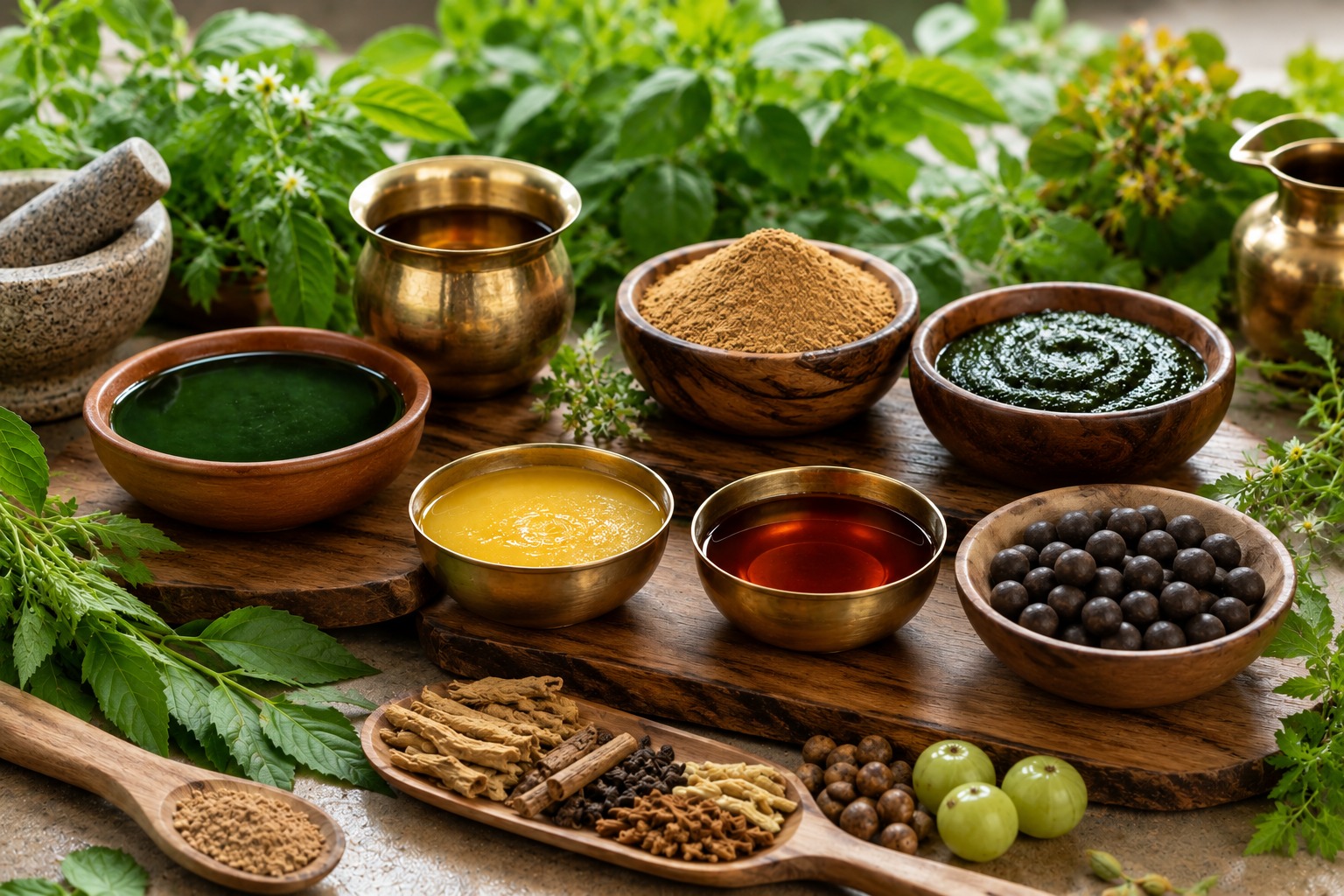
Here, we have rounded up for you the major dosage forms (Aushadha kalpanas) that you would come across in your quest for health and longevity, the Ayurvedic way of life:
-
Swarasa: Swarasa is the undiluted juice expressed from fresh herbs and plant material. It is the most basic form of herbal medicine. However it has the limitation of being a viable dosage form only in the vicinity of these medicinal plants. It has to be consumed as soon as it is prepared and does not store well.
-
Kalka: The paste obtained by grinding the wet medicinal dravya (plant/ animal/ mineral) or its powders along with a suitable adjuvant. Kalka too is a basic formulation which cannot be stored for later use. It may be used as such, or as intermediary for more elaborate preparations like kashaya or tailas.
-
Choorna: Choornas are dry medicated powders. The particle size may vary based on the purpose intended. Stored under sterile conditions, it has a good shelf life.
-
Kashaya: Kashayas are aqueous extracts of therapeutic substances, obtained by subjecting them to continued boiling at moderate temperatures of 70 to 80 degree celsius.
-
Phanta kashaya: Phanta kashayas are simple teas of herbal drugs. The powdered medicine is steeped in hot water, strained and used lukewarm.
-
Asava – Arishta: Asavas and arishtas are medicinal preparations in a mildly alcoholic base. The sweet base of jaggery/ sugar and spices subjected to fermentation makes it palatable and quick acting.
-
Avaleha: These are jam-like preparations that are palatable and nourishing. Mostly they are used in the final stages of treatment for sustained effect and regaining of lost health and vigor.
-
Ghrita: They are medicated ghees. Ghees are inherently pitta pacifying. They pacify the heat and pungency of pitta. Ghritas are also efficient in crossing the blood brain barrier. They are used to deliver medhya rasayanas like Brahmi, which promote the functioning of the intellect.
-
Taila: Medicated oils are called tailas. The popular bases are sesame seed oil, coconut oil and castor oil. Tailas by nature have a calming and grounding effect on vata dosha.
-
Gutika/ Vati: These are hand rolled pills of therapeutic combinations. The pill form traditionally helped in assigning different dosage forms for formulations, based on the size of the pill. When dried well, they have good shelf life and can be transported easily. Traditionally, these pills were advised to be taken dissolved in a suitable adjuvant, for optimum absorption and action.
Modern Innovations and Global Reach
Modern pharma techniques have revolutionised the Ayurvedic medicine industry. Hand rolled pills have been adapted to tablets in blister packs. Traditional dosage forms are now available in handy containers and sterile packing, and subject to stringent quality checks. These changes have facilitated ease of transport, storage and global reach for Ayurvedic medicines.
Beyond Herbalism: Rasaushadhi and Mineral Medicines
Ayurvedic medicine is not restricted to mere herbalism, the therapeutic use of plants. Ashtanga Hridiya, one compendium among the great three (Brihatrayi) of Ayurveda proclaims, “Jagatyevam anoushadham na kinchit vidyathe dravya” – meaning, there is literally nothing in this world that is not medicine or aushadha. Even plain water, given in the right quantity at the right time, acts as medicine.
‘Rasaushadhi’ is one such potent group of medicines in the repertoire of Ayurveda. Alchemy was developed in ancient India even during the pre-vedic period, as evidenced by earliest records of Indian philosophies on nature, from the 5th to 3rd centuries BC. This extended to the vedic system of healing too. Mineral ores, their satwas (metal and non-metal extracts), salts and alkalis were routinely used in medicine. Mercury (Rasa) and Sulphur (Gandhaka) in compound forms rendered organic and harmless to the body by elaborate procedures, forms the base of ‘Rasasastra’ the branch of Ayurveda that practices mineral based drugs for curing diseases. They are characterised by three striking aspects – ‘small doses’, ‘quick action’ and ‘easy administration’.
The Role of Bhasmas
Bhasmas are the main dosage forms of mineral based drugs. It is obtained by subjecting metals to the process of ‘Marana’ or killing. It entails elaborate processes of purification, repeated potencification with herbal ingredients and finally subjecting it to very high temperatures in the range of 700 to 800 degree Celsius. The product obtained is perfectly compatible with the human gut in the right dose and with suitable adjuvants.
Addressing Criticisms and Ensuring Quality
Ayurvedic medicine, especially mineral based drugs have received much criticism from the global community for the presence of heavy metals in them. This is the result of faulty processing, and not a demerit of the concept or practice of Ayurvedic medicine.
Quality raw materials sourced from trusted vendors, systematic processing and stringent quality check should be ensured in the purchase of all herbal and mineral based drugs. These prescribed with a stronghold in the fundamentals of Ayurveda, is definitely the path to health and well-being.