Why does one person feel perfectly comfortable in cold weather while another is constantly reaching for a sweater? Why can some people eat almost anything without much discomfort, while others struggle with acidity or bloating? Why does one person have boundless energy but find it difficult to sit still, while another is calm and steady but takes longer to get moving?
We often dismiss these differences as individual quirks. Ayurveda, however, looks at them a little differently.
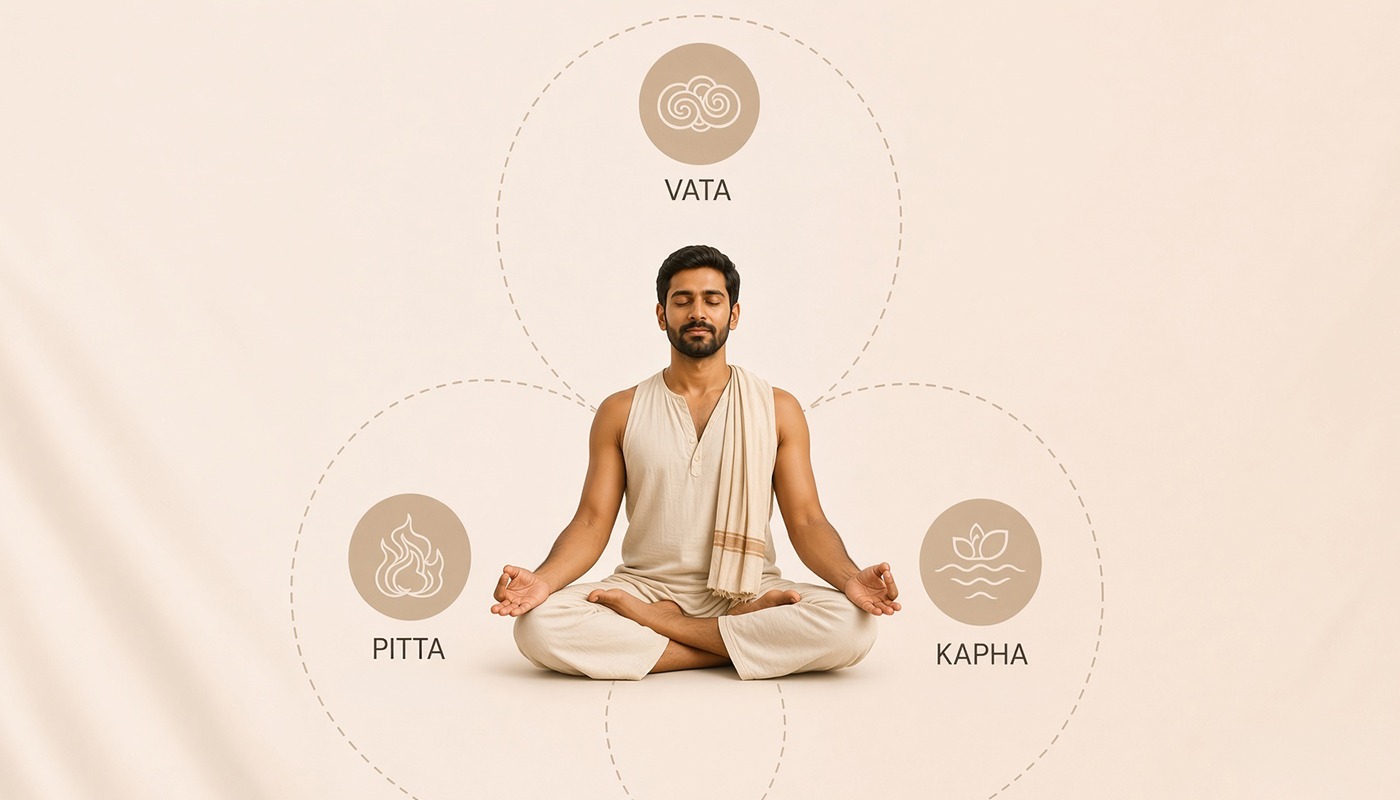
It recognises that every individual has a unique physiological constitution, and that the body functions through three fundamental principles known as Vata, Pitta and Kapha.
Together, they are called the Tridoshas. They form one of the most important foundations of Ayurvedic understanding of health and disease.
But what exactly are these doshas? Are they something we can see or measure? And what does it mean when someone says, “Your Vata is high” or “You have a Pitta imbalance”?
Let’s simplify things.
Three principles, one functioning body
Imagine the human body as a beautifully organised system.
For it to function, three broad activities need to happen. Things have to move, things have to be transformed, and things have to be held together and supported.
Ayurveda describes these functions through the three doshas.
Vata governs movement. Pitta governs transformation. Kapha governs structure and stability.
These are not three separate substances floating around inside us. They are functional principles that help explain the way Ayurveda understands physiological activity.
All three are present in every individual. None is inherently good or bad. Health depends on their appropriate functioning and balance in relation to the individual.
Vata: The principle of movement
Have you ever noticed how your body responds when you are anxious or excited? Your heart beats faster, your breathing changes, your thoughts race and you may even experience butterflies in your stomach.
Movement is happening everywhere.
In Ayurveda, Vata is associated with movement and communication within the body. It is linked to activities such as breathing, circulation, nerve impulses, movement of muscles and joints, and the movement of food through the digestive tract.
People with a Vata-dominant constitution are traditionally described as being energetic, quick-thinking, creative and adaptable. They may enjoy variety and change. On the other hand, they may also tend towards irregular routines, dryness, variable appetite and disturbed sleep.
When Vata becomes aggravated, symptoms may include constipation, bloating, dryness, restlessness, disturbed sleep, tremors or certain types of pain.
Think of a vehicle. Movement is essential, but an engine that keeps running at excessive speed without adequate maintenance will eventually struggle.
Similarly, Vata needs appropriate nourishment, rest, warmth and regularity.
Pitta: The principle of transformation
Think about what happens to the food you eat. It is broken down, digested and transformed into substances that the body can absorb and utilise.
Transformation is taking place.
This is the domain of Pitta.
Pitta is associated with digestion, metabolism, body temperature and various biochemical processes. It also has a role in how Ayurveda understands perception, comprehension and intellectual discrimination.
People with a Pitta-dominant constitution are traditionally described as focused, organised, determined and sharp in their thinking. They often enjoy challenges and may have a strong appetite and a preference for cooler environments.
When Pitta becomes aggravated, it may manifest as excessive heat, acidity, burning sensations, inflammatory skin complaints, irritability or increased sensitivity to heat.
Imagine a kitchen stove. Without sufficient heat, food remains uncooked. With excessive heat, it burns.
Pitta is much the same. Transformation is essential, but it needs to happen within appropriate limits.
Kapha: The principle of structure and stability
Now imagine what holds the body together.
Bones, muscles, joints, tissues and the various structures that give the body its form and stability.
Ayurveda associates these qualities with Kapha.
Kapha represents structure, cohesion, lubrication, nourishment and stability. It is associated with the body’s ability to maintain its physical framework and provide resilience.
People with a Kapha-dominant constitution are traditionally described as being steady, patient, calm and enduring. They may have good physical stamina and a preference for routine. However, they may also tend towards sluggishness or find it difficult to adapt to sudden changes.
When Kapha becomes aggravated, symptoms may include heaviness, excessive mucus, congestion, lethargy, fluid accumulation and a tendency towards weight gain.
Think of a house. It needs a strong foundation and solid supporting structures. But excessive weight or poor maintenance can compromise its functioning.
Kapha provides stability, but too much stagnation can become a problem.
So, which dosha are you?
This is where things get interesting.
You may have come across online quizzes that promise to identify whether you are Vata, Pitta or Kapha.
While these can be entertaining introductions to Ayurveda, they cannot replace a proper assessment.
Every individual has all three doshas. What differs is their relative predominance, which Ayurveda describes as Prakriti, or one’s natural constitution.
Some people have a clear predominance of one dosha. Others have combinations, such as Vata-Pitta, Pitta-Kapha or Vata-Kapha. Some have a relatively balanced constitution.
Your Prakriti is traditionally understood to be established at conception and remains relatively stable throughout life.
However, the way your body functions can change with age, seasons, food habits, lifestyle, environment and health conditions.
This brings us to another important concept: Vikriti.
While Prakriti refers to your natural constitution, Vikriti refers to your current state of imbalance or deviation from that constitution.
In simple terms, Prakriti is your natural blueprint. Vikriti is what may be happening to your body right now.
A person with a Kapha-dominant constitution can develop Vata-related symptoms. Someone naturally Pitta-dominant can experience Kapha aggravation.
This is why simply identifying your dominant dosha is not enough to understand your health.
Why does this matter in treatment?
Imagine three people walking into a clinic with the same complaint: constipation.
One has dryness, irregular meals and disturbed sleep. Another has constipation accompanied by acidity and a burning sensation. The third experiences sluggish digestion, heaviness and a feeling of incomplete evacuation.
The complaint is the same, but the associated patterns are different.
An Ayurvedic physician does not look at the disease name alone. The assessment considers the doshas, tissues involved, digestive capacity, strength, constitution, age, season and several other factors.
The treatment, including dietary recommendations, medicines and therapies, is planned accordingly.
This is also why the same medicine or diet may not be suitable for everyone with the same diagnosis.
The objective is not to make everyone Vata, Pitta or Kapha dominant. It is to understand the individual’s needs and restore appropriate functioning.
Balance is not about being the same
One common misconception is that all three doshas should exist in exactly equal proportions for a person to be healthy.
That is not what Ayurveda suggests.
A naturally Vata-dominant person does not need to become Kapha-dominant to achieve health. The objective is to maintain the doshas in a state appropriate to that person’s constitution.
It is also important to remember that not every symptom can be explained by dosha imbalance alone. Persistent or concerning symptoms need proper medical evaluation, and Ayurvedic assessment should complement, not replace, appropriate investigations and necessary treatment.
Understanding yourself is the first step
Perhaps the most valuable lesson from the concept of Tridosha is that health cannot be approached with a one-size-fits-all formula.
Your friend may thrive on a particular diet or exercise routine. That does not automatically make it suitable for you.
Your body has its own constitution, its own strengths and its own vulnerabilities.
The more we understand these differences, the better equipped we are to make informed choices about food, activity, rest and treatment.
Vata reminds us of movement. Pitta reminds us of transformation. Kapha reminds us of stability.
All three are essential. All three work together.
The secret of health is not to fight your constitution, but to understand it.
Because Ayurveda isn’t about fitting every individual into the same prescription. It is about understanding the individual before deciding what the prescription should be.
The Three Doshas: Understanding the Unique Blueprint of Your Body